Does Rooftop Solar Keep the Lights On in a Blackout?
Last updated By The SolarPanelFinder Rooftop Desk
No, not on its own. Most grid-connected solar arrays without a battery switch off when the power fails, even in full sun, because their inverters are built to shut down when the grid does. To keep anything running, a home almost always needs a battery, or a generator, set up and wired for backup, and even then only the circuits it was designed to carry stay on.
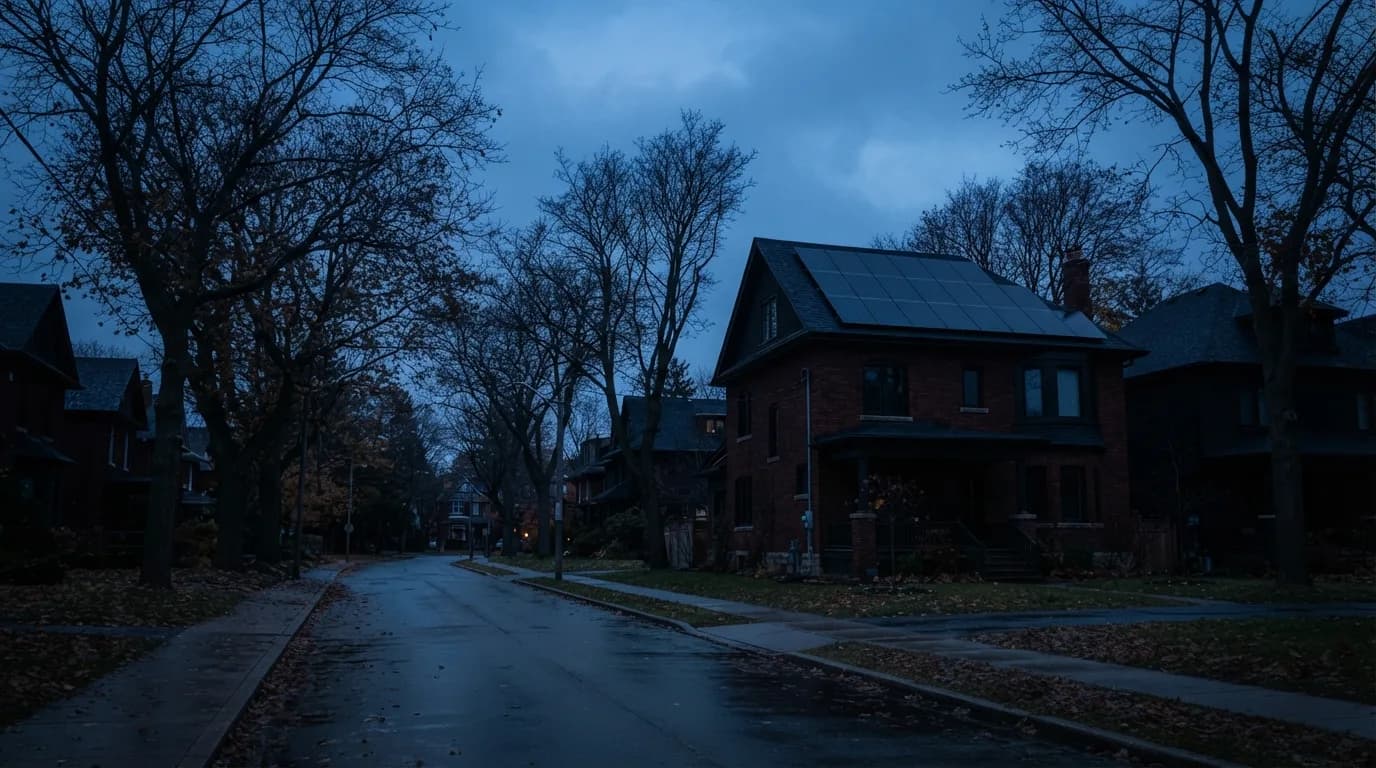
Why does a solar array shut off when the grid goes down?
Because the inverter is designed to. The inverter is the box that turns the panels' direct current into the alternating current your home uses. Ontario's Electrical Safety Authority (ESA) describes one type, called a grid dependent inverter, in its guideline for small inverter-based systems: "Loss of power from the grid will initiate a shutdown of the inverter to prevent islanding."
An island is a stretch of power line that a home system keeps live after the utility's supply is gone. The guideline says systems using a grid dependent inverter "will not provide back-up power during a utility power outage". It also says the inverter must meet the anti-islanding requirements of the CSA C22.2 No. 107.1 standard. The guideline is dated April 2010, and Hydro Ottawa still publishes it on its website.
BC Hydro, a British Columbia utility, puts it in plain terms: "During a power outage, most self generation systems will automatically shut off." It says this stops electricity flowing back into the grid, which helps keep crews, emergency responders and the public safe, and adds: "This means your home will be without power until electricity is restored to our grid."
Natural Resources Canada describes how the two kinds of system differ. Off-grid systems "usually require storage, such as batteries". Grid-connected systems can include storage as well, but they "generally feed any excess electrical energy production to the grid". Put that together with the shutdown rule above, and the sun can shine on a full array while the house sits dark. Nothing is broken.
Can you switch the panels back on yourself?
No. BC Hydro is direct about it: "You must not attempt to bypass safety features or manually energize electrical equipment during an outage."
The ESA guideline also requires a labelled disconnect switch between the system and the utility's lines. It says that disconnect "ensures the safety of electrical utility workers by allowing them to disconnect the generator from the utility system". Generator here means your solar system. A crew working on a dead line is counting on your array staying off.
What does a home system need to keep power on?
Three things: a battery, an inverter that can run without the grid, and wiring designed for backup. The same ESA guideline describes a second inverter type, the grid-interactive inverter, which can run either connected to the grid or on its own. It says this type "can be considered as an uninterruptible power supply".
BC Hydro says "Only battery systems and configurations approved by BC Hydro are permitted to provide backup power during a power outage." It adds that backup depends on how the system is designed, wired and commissioned by a qualified professional. Commissioning is the final setup and testing once the system is installed. In a backup setup, BC Hydro says, the battery disconnects from the grid by itself and feeds a set of backup circuits chosen in advance. "Not all appliances will be powered, unless your system is specifically designed to do so."
So a battery added only to store daytime solar for the evening is not automatically a backup battery. Ask in plain words whether the system will power the house in an outage, and get the list of backed-up circuits in writing.
Ontario utilities set their own connection steps. Toronto Hydro's connection process covers battery storage as well as solar, and the utility says it has recently lifted size restrictions on solar and storage systems for almost all customers. Ask the installer what your local utility needs before a backup system is wired in.
Can the panels recharge the battery during a blackout?
Sometimes. BC Hydro says the panels can be reconnected to the battery and, if conditions allow, recharge it during an outage. It adds: "To have your self-generation system automatically reconnect to your battery during an outage it must be set up by the installer at the time of installation." It also warns that a battery may stop when its stored energy runs out and may not recharge if solar generation is limited or unavailable, so it should not be the sole source of life-sustaining power.
Season matters in the GTA. Natural Resources Canada's municipal solar data estimates that in Toronto, south-facing panels tilted at the latitude angle produce 128 kWh (kilowatt-hours, the unit of energy a battery stores) per kW of panels in July and 51 in December, so July's figure is about 2.5 times December's. NRCan says its monthly values are only indicative and do not account for snowfall, temperature or year-to-year swings in sunshine, so a winter outage can leave a battery with little to recharge from.
How long does backup power last?
It depends on the battery's size, which backup circuits are on, how much power those appliances use, and whether solar can top the battery up in daylight, according to BC Hydro. Its example for essential loads only, such as lights, a fridge and wi-fi, is that they "will last several hours to more than a day".
Hydro One gives an Ontario example. Its Residential Reliability Improvement program, aimed at neighbourhoods with many outage hours, puts Tesla Powerwall batteries in participants' homes. Hydro One says the system for the program "includes two batteries, totalling 27 kWh of capacity". Hydro One says that setup provides "10-40 hours of back-up power depending on your household usage", and its FAQ adds that this is not a guarantee. Applications are now closed, and those figures are the utility's own description of its own setup.
To work out a figure for your house, the site's battery sizing guide walks through the circuit list and the arithmetic.
Is a generator the safer bet?
It is a different trade-off, with its own safety rules. The Government of Canada's Get Prepared guidance says "A back-up generator may only be connected to your home's electrical system through an approved transfer panel and switch that has been installed by a qualified electrician", and that you should never plug a generator into a wall outlet. A transfer panel is the switch that moves the house between power sources. In Ontario, the ESA says only a Licensed Electrical Contractor can be hired to do electrical work in your home. Ontario's carbon monoxide guidance lists generators among the sources of the gas and says to "Only use portable fuel-burning generators outdoors in well-ventilated areas", away from any window, door or vent. Get Prepared adds that battery- or solar-powered portable generators do not produce carbon monoxide.
A battery is quiet and burns no fuel, but it holds a fixed amount of energy. A fuel generator runs for as long as it has fuel. The site's guide to off-grid solar in Ontario explains how the two are combined when there is no grid at all.
Who in the GTA lists battery work?
In this index, 16 of the 161 solar companies list battery storage, and 14 of those also list panel installation. The site links a website for 15 of the 16, and a company's own website or its listing profile is the place to start asking about backup. The site's guide to comparing home battery quotes covers how to read their prices, and the battery cost guide lists the published ranges with their sources.
Backup wiring is electrical work. The ESA says "Licensed Electrical Contractors (LECs) are the only businesses in Ontario legally authorized to do electrical work in your home", and that each one has a 7-digit ECRA/ESA licence number you should ask to see before hiring. It also says the Ontario Electrical Safety Code "requires almost all electrical work be reported to the Electrical Safety Authority" through a notification that should be filed before the work starts. The index does not check licences for any company, so ask who will do the electrical part and who files the notification. The site's guide to who does the electrical work on a solar install covers that side in detail.
Questions to ask before you buy backup
- Will this system power the house during an outage, and exactly which circuits?
- Is the inverter able to run without the grid, and is that in writing?
- Will the panels recharge the battery during an outage on their own, or only after someone reconnects them?
- How long do you estimate it will run those circuits, and on what assumptions?
- Does my utility need to approve the backup setup?
- Who does the electrical work, what is their ECRA/ESA licence number, and who files the ESA notification?
Once it is in, BC Hydro's advice applies anywhere: know which circuits are connected to backup power, and keep the battery charged before major storms.
Frequently asked questions
Do solar panels work during a power outage?
- Not on their own, if the system is connected to the grid. Usually the inverter shuts down when grid power is lost, so the panels stop feeding the house. BC Hydro says most such systems shut off automatically to keep crews and the public safe. A battery and wiring set up for backup are needed to keep anything running.
Can I switch my solar system back on myself during an outage?
- No. BC Hydro says you must not bypass safety features or manually energize electrical equipment during an outage. A 2010 guideline from Ontario's Electrical Safety Authority also requires a disconnect that lets utility workers cut the system off from the grid while they work.
Can a battery recharge from solar during an outage?
- Sometimes. BC Hydro says a battery can be recharged during an outage if conditions allow, but automatic reconnection must be set up by the installer at the time of installation. It may not recharge if there is little or no sun, so BC Hydro advises against relying on battery storage as the sole source of life-sustaining power.
How long will a home battery run during a blackout?
- It depends on the battery's size, which circuits stay on, how much power they use and whether the sun can top it up. BC Hydro says essential loads such as lights, a fridge and wi-fi can last several hours to more than a day. Hydro One says the two-battery, 27 kWh setup in its now-closed outage program provides 10 to 40 hours of backup, depending on household use, which Hydro One says is not a guarantee.
Who installs solar battery backup in the GTA?
- In this index, 16 of the 161 solar companies list battery storage, and 14 of those also list panel installation. Backup wiring is electrical work, and Ontario's Electrical Safety Authority says only Licensed Electrical Contractors may be hired to do it in your home.
Sources
- Electrical Safety Authority, Electrical Guidelines for Inverter-Based Micro-Generating Facility (ESA-SPEC-004, April 2010), as published by Hydro Ottawa
- BC Hydro, Self-generation and power outages
- Natural Resources Canada, Solar Photovoltaic Energy in Buildings
- Natural Resources Canada, Photovoltaic potential and solar resource maps of Canada
- Natural Resources Canada, Photovoltaic potential by municipality (data table)
- Toronto Hydro, Generation and storage connection process
- Hydro One, Residential Reliability Improvement Program
- Government of Canada, Get Prepared, Power outages
- Government of Ontario, Carbon monoxide safety
- Electrical Safety Authority, Finding the Right Contractor
- Electrical Safety Authority, Notifications and Inspections