Off-grid solar in Ontario, and what it costs
Last updated By The SolarPanelFinder Rooftop Desk
Off-grid is a different product, not a bigger one
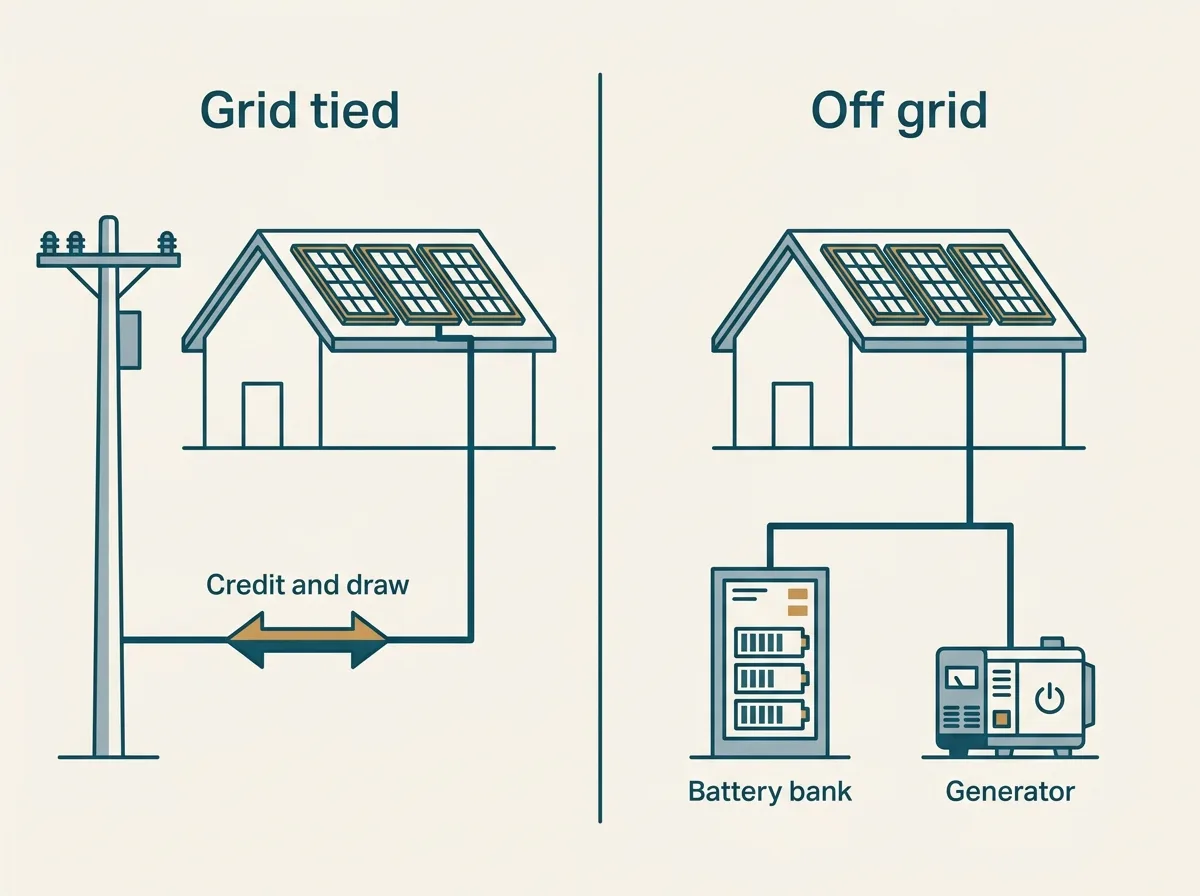
A grid-tied array borrows the grid as its storage. Whatever the roof makes and the house does not use goes out to the utility and comes back as a credit on the bill, and whatever the house needs after dark comes off the grid at the usual price.
An off-grid system has none of that. Every kilowatt hour the house uses at 11pm in February has to have been generated earlier and held somewhere, and the somewhere is a battery bank sized for the worst stretch of weather you are willing to plan around. That is the whole difference, and it is why the two systems are priced on different logic.
So the questions change as well. A grid-tied project asks how much of your annual consumption you want to offset. An off-grid project asks how many days of poor generation the system has to carry before something else has to run, and how much of the house stays live while it does.
Two Canadian sources, two different answers
The two Canadian sources we could verify disagree sharply on what an off-grid system costs, so this site widens the range rather than picking a winner.
Off Grid Solar System Canada puts a small cabin system of 1.5 to 3 kW at $14,050 to $24,150 fully installed, a full-time family home of 5 to 8 kW at $36,200 to $67,500, and a large property of 10 to 15 kW at $76,000 to $144,500. Volts.ca puts a small cabin or tiny home at $10,000 to $15,000 complete and a full-time family home at $20,000 to $35,000 complete.
Read the two sources together and a cabin is roughly $10,000 to $24,150 and a full-time home roughly $20,000 to $67,500. That is an uncomfortable range to publish and it is the honest one. A three-fold spread on a whole-system figure is a signal that the two sources are describing different systems, not that one of them is wrong.
The difference is mostly the battery bank. Volts.ca sizes a family home bank at 15 to 25 kWh for $9,000 to $14,000, while Off Grid Solar System Canada sizes the same household at 25 to 40 kWh for $16,000 to $28,000. A bank sized for three cloudy Ontario winter days costs far more than one sized for a summer weekend, and both are legitimate designs for different uses of the same building.
Storage is the budget, and everything else is smaller
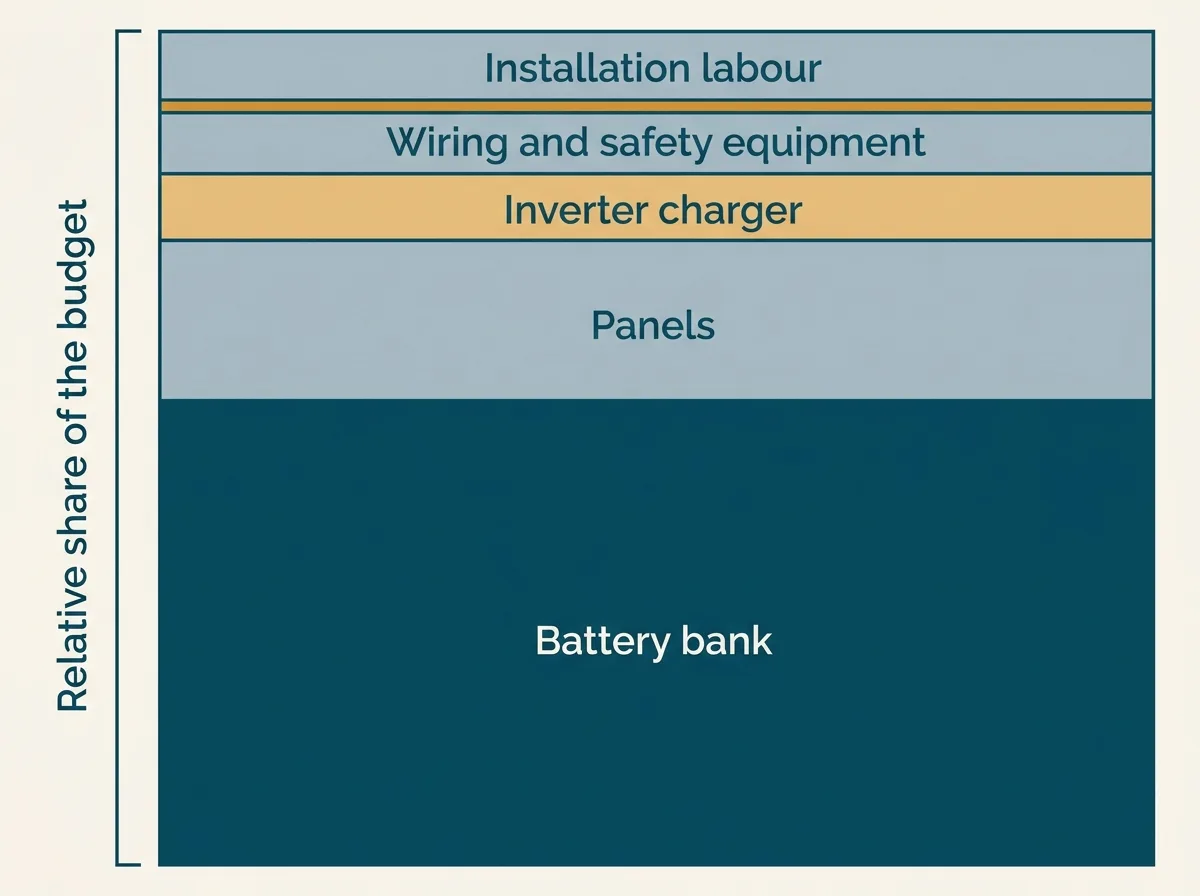
Off Grid Solar System Canada prices a lithium iron phosphate battery bank at $550 to $800 per kWh installed. On any full-size build that single line is often more than the panels, the inverter and the labour combined.
By application, Off Grid Solar System Canada puts a cabin bank of 10 to 15 kWh at $6,500 to $10,000, a family home bank of 25 to 40 kWh at $16,000 to $28,000, and a large property bank of 50 to 80 kWh at $32,000 to $58,000. Capacity is the price, and capacity follows directly from how many days of autonomy the design has to cover.
Against that, panels are inexpensive. Off Grid Solar System Canada prices modules at $0.35 to $0.65 per watt supply-only and $0.80 to $1.20 per watt installed. SolarCalculatorHQ puts a grid-tied residential system in Toronto and the GTA at $2.95 to $3.30 per watt, because grid-tied pricing carries permitting, utility interconnection and a different class of inverter that an off-grid build does not.
The rest of the system is a set of familiar lines. Off Grid Solar System Canada puts an inverter-charger for a 3 to 5 kW system at $1,500 to $3,500 and for a 6 to 10 kW system at $3,500 to $7,000, a charge controller at $400 to $900, wiring, disconnects and safety equipment on a full-size system at $2,000 to $6,000, and installation labour at $2,500 to $5,000 for a cabin or $6,000 to $12,000 for a family home. Volts.ca puts monitoring at $750 to $1,200.
Why a well-designed Ontario system is oversized on the roof
Because panels cost a fraction of what storage costs, an off-grid system in this climate is usually built with more array than a summer day needs.
The reasoning is straightforward arithmetic. On Off Grid Solar System Canada's figures, adding a kilowatt of panel is $800 to $1,200 installed while adding a kilowatt hour of battery is $550 to $800, and a winter day in Ontario may need several of those kilowatt hours to cover one short generating day. Extra array harvests the thin December light that a correctly sized summer system would waste, and it is the cheaper way to buy the same reliability.
Almost every off-grid build in Ontario also keeps a generator, and that is a design decision rather than an admission of failure. Off Grid Solar System Canada puts generator integration with an automatic transfer switch and wiring at $2,000 to $4,500. What the generator actually buys is a smaller battery bank: without it, the storage has to cover the worst week of the year rather than the ordinary bad one.
Site location moves the labour line as well. Off Grid Solar System Canada notes a labour premium of 10 to 15 percent in southern Ontario and 25 to 45 percent in the north, which on a family home installation of $6,000 to $12,000 is a real number on a property that is hard to reach.
What off-grid removes from the paperwork, and what it does not
An off-grid system that never connects to a distribution company is outside the net metering arrangement entirely. There is no credit, because there is no export, and there is nothing to apply for with a utility.
What does not go away is electrical safety. SurgePV states that installations connected to the electrical system in Ontario need an ESA permit filed as a Notification of Work by a licensed Electrical Contractor before work begins, and the Electrical Safety Authority puts the minimum residential notification fee at $88. Any system feeding a building's wiring is electrical work on a building, and the structural side of a mounting arrangement is still a municipal question.
Hybrid arrangements are where the confusion lives. A property that keeps a grid connection and adds storage is not off-grid, and it sits under the same rules as any other grid-tied system: the Ontario Energy Board describes net metering as a credit against the electricity you use, carried forward for at most 12 months before dropping to $0. What Ontario net metering actually pays you covers that side, and how to compare home battery quotes in Ontario covers storage on a connected house.
Before anything is ordered, one provincial question is worth settling in writing. Ontario's Home Renovation Savings programme and net metering cannot both apply to a single installation, and the programme requires written approval ahead of purchase and installation. Our Ontario solar programmes page is the single place on this site holding those rules.
Who quotes this work in the GTA
Three of the 161 companies in this index list off-grid solar. It is the smallest category on the site, alongside solar design and consulting at three and solar roofing and repair at four each.
That count is a fact about this index rather than about Ontario. Off-grid work is often done by specialists based near the properties they serve rather than by firms with a Greater Toronto Area address, and a directory built on GTA business listings will under-represent exactly that. The honest reading is that this site is not the right place to shop an off-grid build, and saying so is more useful than presenting three records as a market.
What this index holds is what a company's own listing supports. It records no licence status, no certification, no bonding, no scope of work and no completed-project history for any of the 161 companies, and 90 of them carry a public rating at all. Our methodology page sets out those limits directly.
For the costs themselves, our off-grid solar cost guide carries every figure above with its source in the same sentence, and the solar battery storage cost guide covers the storage side for a connected house.
What to ask before you commit
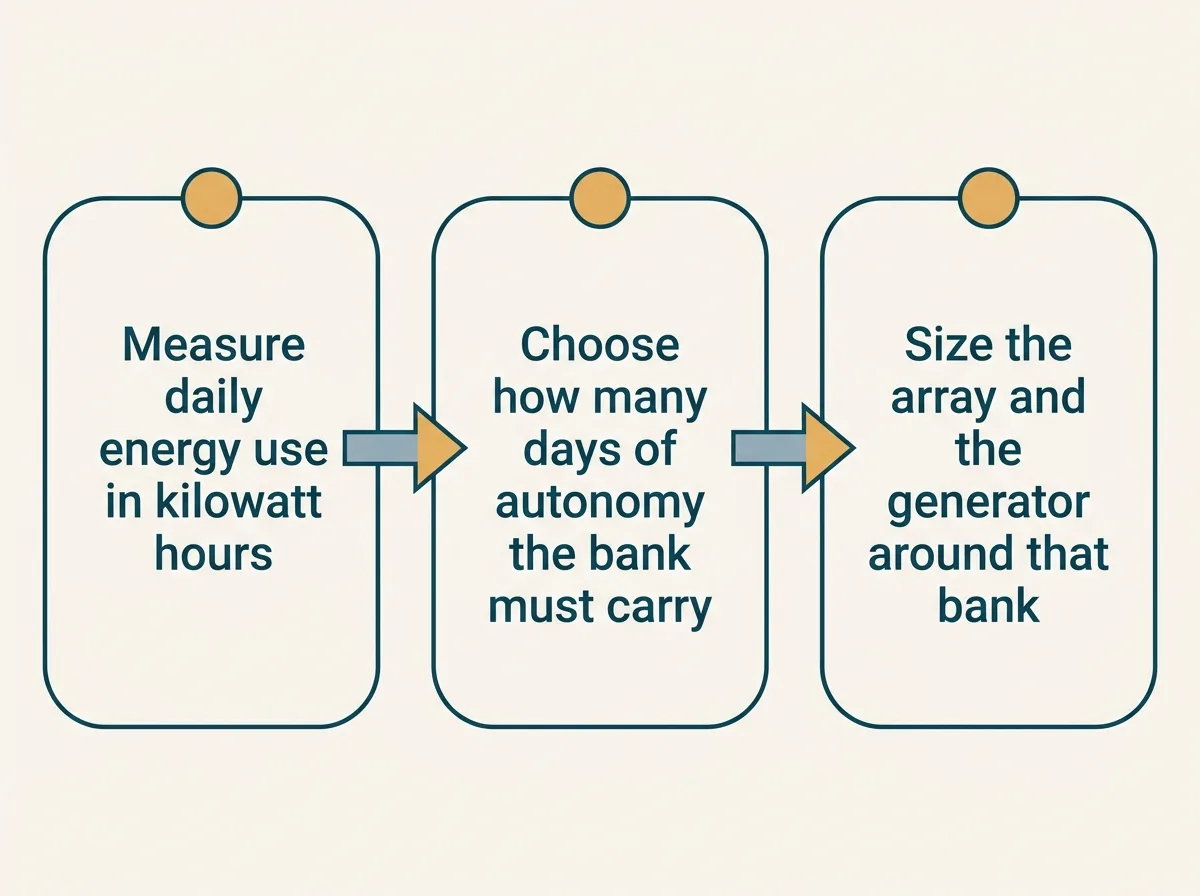
Ask what daily energy use the design assumes, in kilowatt hours, and where that number came from. Every other figure in an off-grid quote is downstream of it, and a proposal that starts from a system size rather than from consumption has skipped the only measurement that matters.
Ask how many days of autonomy the battery bank is sized for. That single choice is the difference between Volts.ca's 15 to 25 kWh family home bank at $9,000 to $14,000 and Off Grid Solar System Canada's 25 to 40 kWh bank at $16,000 to $28,000 for the same household.
Ask whether a generator is in the design, and at Off Grid Solar System Canada's $2,000 to $4,500 for integration with an automatic transfer switch, ask what it lets the battery bank shrink to. A design with no generator and a modest bank is making an assumption about Ontario weather that deserves to be stated out loud.
Ask for the balance of system as its own line. Wiring, disconnects and safety equipment run $2,000 to $6,000 on a full-size build according to Off Grid Solar System Canada, and it is the section of a quote that most often turns out to mean different things to different bidders.
And get the site access understood before the labour is priced. Off Grid Solar System Canada's 25 to 45 percent northern labour premium is a real number, and it is cheaper to know about it at the quoting stage than to discover it when a crew is trying to reach a property in April.
Frequently asked questions
How much does an off-grid solar system cost in Ontario?
- Sources disagree, so read Off Grid Solar System Canada and Volts.ca together: a cabin is roughly $10,000 to $24,150 and a full-time home roughly $20,000 to $67,500. Off Grid Solar System Canada puts a 1.5 to 3 kW cabin at $14,050 to $24,150 and a 5 to 8 kW family home at $36,200 to $67,500, while Volts.ca puts the same categories at $10,000 to $15,000 and $20,000 to $35,000. Most of the gap is battery sizing.
Why is the battery bank so expensive?
- Because it is the whole of the storage. Off Grid Solar System Canada prices lithium iron phosphate at $550 to $800 per kWh installed, which puts a cabin bank of 10 to 15 kWh at $6,500 to $10,000, a family home bank of 25 to 40 kWh at $16,000 to $28,000, and a large property bank of 50 to 80 kWh at $32,000 to $58,000. On a full-size build the bank often exceeds panels, inverter and labour combined.
Are panels cheaper on an off-grid system?
- Yes, considerably. Off Grid Solar System Canada prices modules at $0.35 to $0.65 per watt supply-only and $0.80 to $1.20 per watt installed, against $2.95 to $3.30 per watt for a grid-tied residential system in Toronto and the GTA according to SolarCalculatorHQ. Grid-tied pricing carries permitting, utility interconnection and a different class of inverter.
Does an off-grid system need a generator?
- Most Ontario builds keep one, and it is a sizing decision rather than a fallback. Off Grid Solar System Canada puts generator integration with an automatic transfer switch and wiring at $2,000 to $4,500. Without it the battery bank has to be sized for the worst week of the year instead of an ordinary bad one, which costs more than the generator does.
Does off-grid solar still need permits in Ontario?
- Electrical safety approval does not go away. SurgePV states that installations connected to the electrical system in Ontario need an ESA permit filed as a Notification of Work by a licensed Electrical Contractor before work begins, and the Electrical Safety Authority puts the minimum residential notification fee at $88. What a true off-grid system does not need is a net metering application, since there is no export to credit.