Sizing a Home Battery for GTA Outages
Last updated By The SolarPanelFinder Rooftop Desk
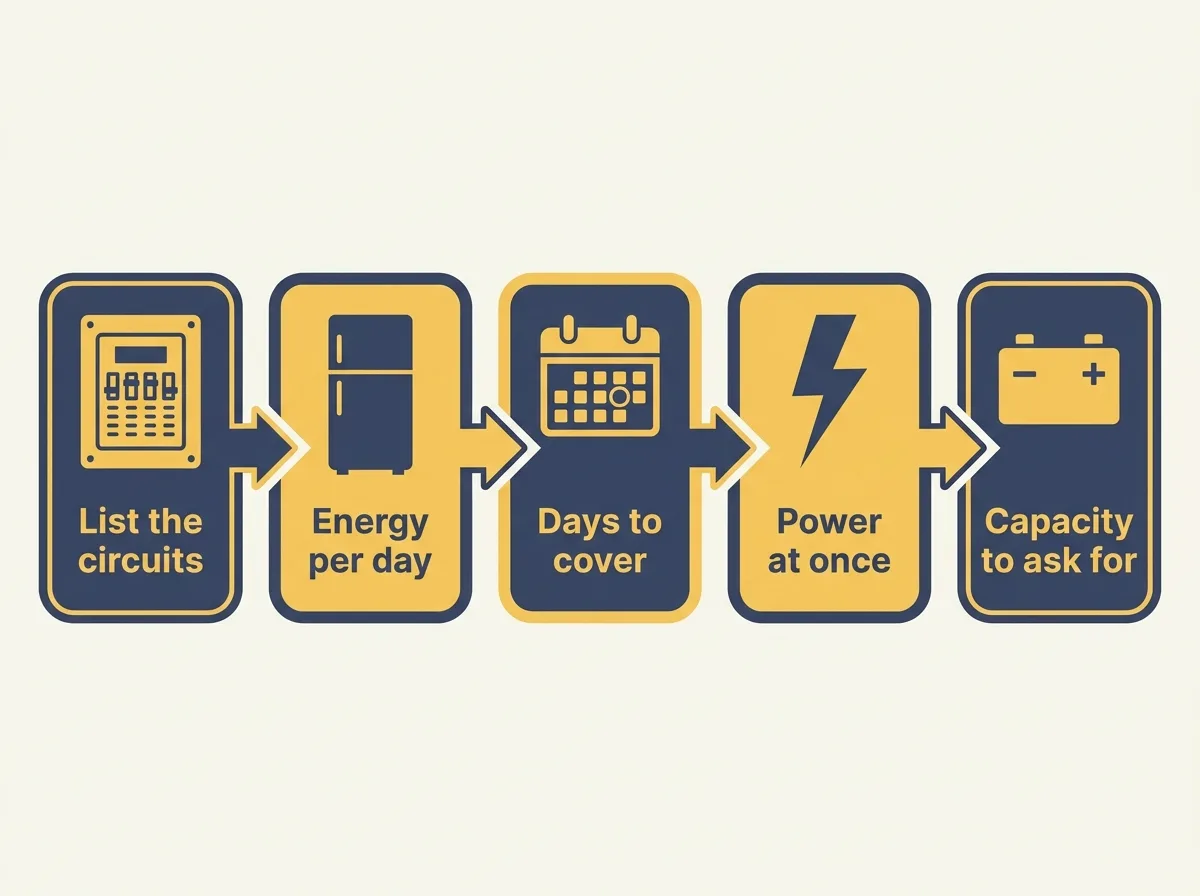
Start with a list of the circuits you need during an outage, not with a product. Add up how much energy each item uses in a day, multiply by the days you want covered, and check how much power has to flow at once. That gives you a capacity figure. Then each battery quote can be checked against it.
What is the difference between kW and kWh?
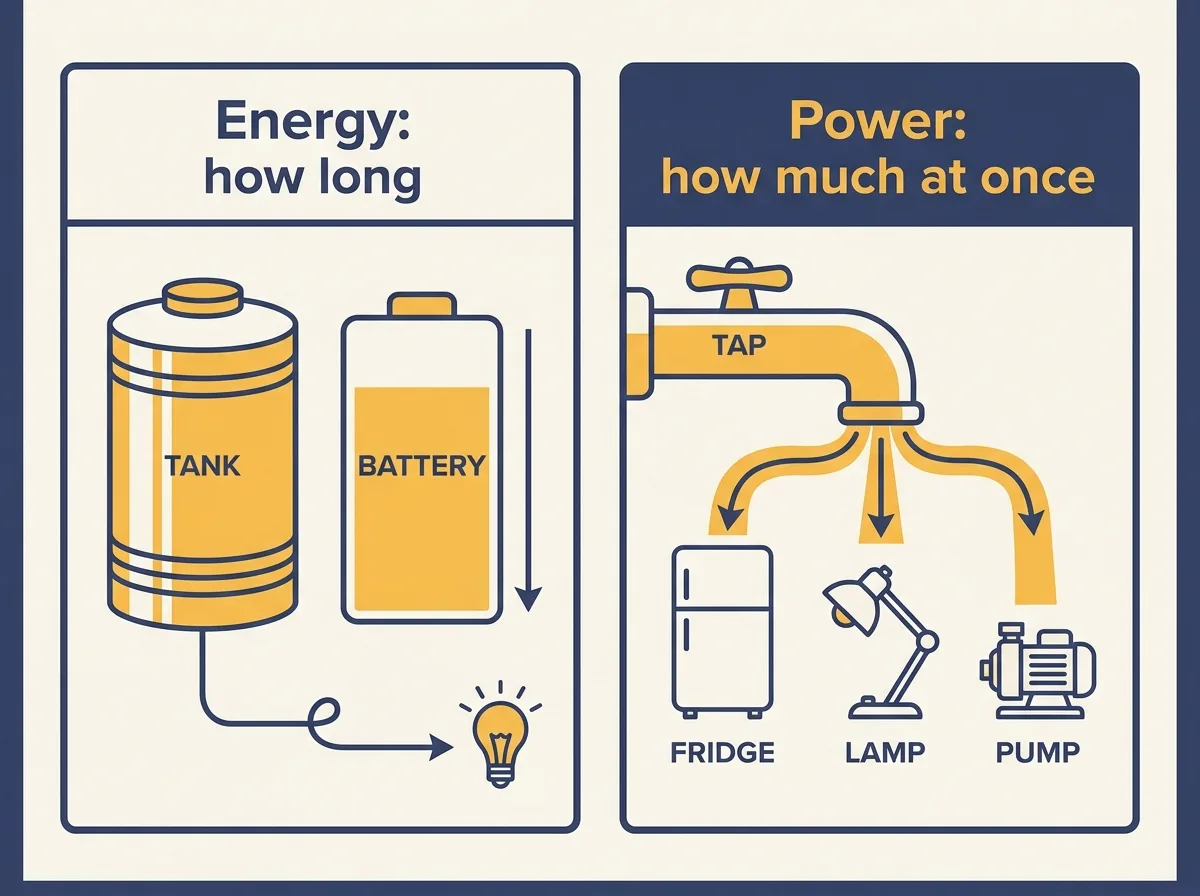
A kilowatt (kW) measures power, the rate at which electricity flows at one moment. A kilowatt-hour (kWh) measures energy, the amount used over time. The Ontario Energy Board (OEB) puts it plainly: "One kilowatt-hour is the same as using 1,000 watts of electricity for one hour."
A battery has a rating for each, and they answer different questions. The kWh rating says how long the battery can keep things running. The kW rating says how many things can run together. Enphase's data sheet for its IQ Battery 5P shows both: a usable energy capacity of 5.0 kWh and a continuous power rating of up to 3.84 kVA per module. A kVA (kilovolt-ampere) is the unit inverter ratings often use, and it sits close to a kW.
A battery can fall short on either side. With too few kWh, it runs out overnight. With too few kW, it can shut off when a pump and a kettle start together, even with charge left.
Which circuits belong on the list?
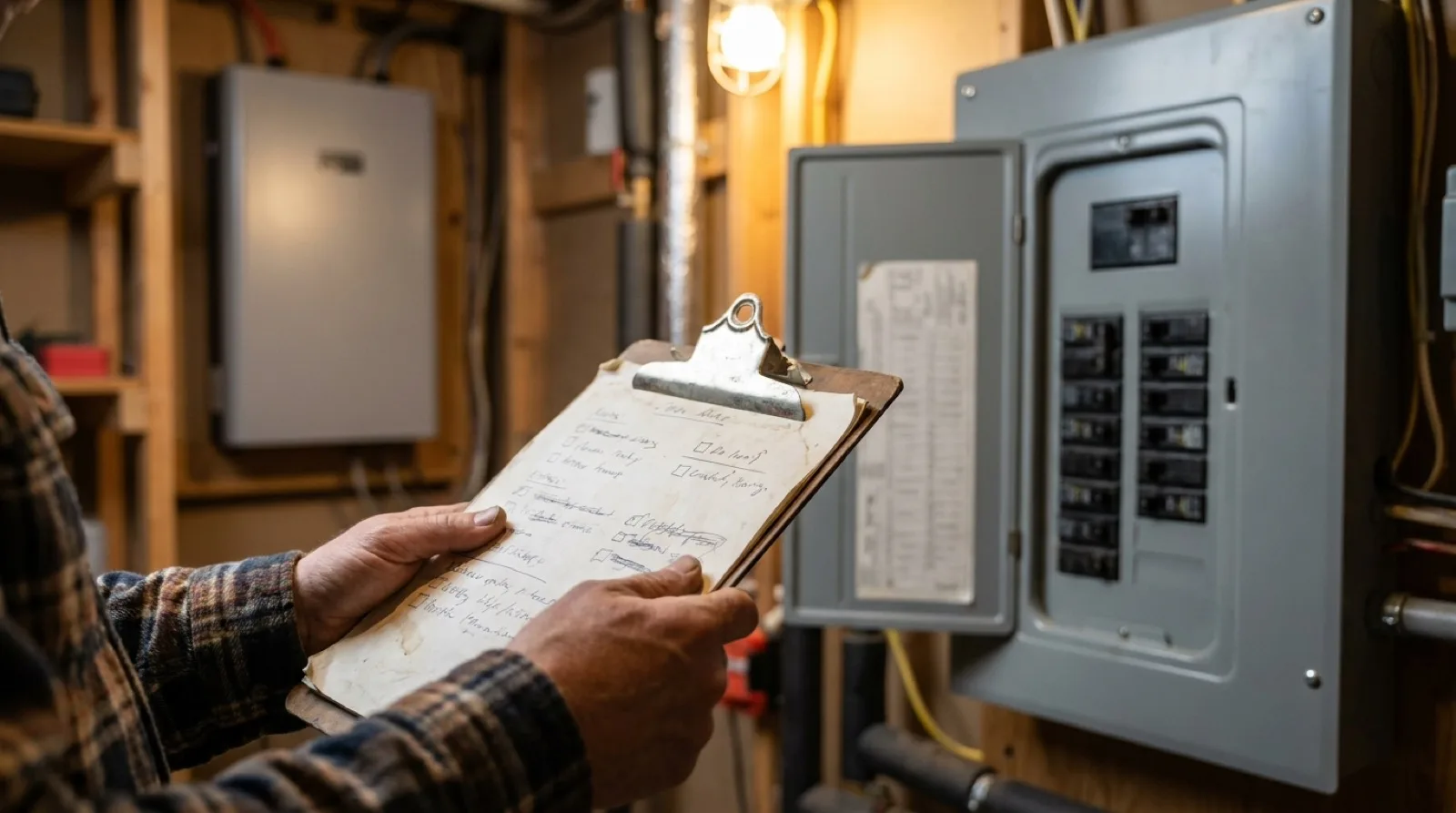
Only the ones you would miss in the first hours of a blackout. A circuit is one breaker in your electrical panel and the outlets or appliances it feeds. A backup battery is often wired to a small group of these, through a separate critical-loads subpanel. The site's battery storage cost guide notes that this subpanel is its own electrical line item and is not always inside a headline battery price.
Walk through the house and write down each item and its breaker. A first list might include:
- the fridge and any chest freezer
- a few lighting circuits
- the internet router and phone chargers
- the sump pump, if the basement floods
- the furnace fan, if the furnace itself runs on gas
- a medical device, if anyone in the house depends on one
Then note what stays off. BC Hydro, a British Columbia utility, warns that high energy loads such as "electric heat, ranges, EV chargers" can drain a battery much faster. It also says not to rely on battery storage as the only source of life-sustaining power, so a medical device needs its own plan.
How much energy does each item use in a day?
For major appliances, the EnerGuide label answers it. Natural Resources Canada (NRCan) says the mandatory label shows an appliance's "annual energy consumption in kWh". Divide that number by 365 and you have a daily figure for your list.
NRCan also publishes averages for new appliances shipped in Canada. Refrigerators shipped in 2019 averaged 471.2 kWh a year, which works out to about 1.3 kWh a day. Freezers shipped that year averaged 324.5 kWh a year, or about 0.9 kWh a day. Your own models may differ, so use their labels if you can find them.
Lighting is easy to work out by hand. The OEB says running 100 10-watt LED bulbs for one hour uses 1 kWh. So six of those bulbs left on for five hours use 0.3 kWh (six times 10 watts times five hours is 300 watt-hours).
Add those three and a short list comes to about 2.5 kWh a day. That total leaves out the router, the sump pump and the furnace fan. The site found no Canadian public source with a daily figure for those items, which vary by model and by how often they run. Read the nameplate on each unit, and ask the electrician who sizes the system to estimate their hours.
How many days should the battery cover?
That is your call, but Ontario guidance gives a benchmark. Hydro Ottawa advises having a backup power plan for a sump pump with "enough power to last 72 hours". Three days is a reasonable test for an essentials list.
The arithmetic scales directly. The 2.5 kWh a day above, times three days, is 7.5 kWh before the pump, fan and router are added.
A whole house is a different order of size. The OEB's 2023 report "reaffirms the consumption for a typical residential customer is 750 kWh per month". That is 9,000 kWh a year, or about 24.7 kWh a day (9,000 divided by 365). Three days of that is about 74 kWh, the usable capacity of almost 15 of the 5.0 kWh modules in Enphase's data sheet.
Panels can top a battery up during a sunny outage, but only if the system is set up for it. For sizing, assume grey days and count on stored energy alone.
How much power has to flow at once?
Enough to run everything on your list that can switch on together. Add up the running watts of those items, then look at motors separately. A motor draws a surge when it starts. Equipment makers rate this as locked rotor amps (LRA), the current a motor pulls in the instant it starts turning.
Manufacturers state these figures differently, and not every data sheet can be opened:
- Tesla Powerwall 3: Tesla's own pages and datasheet returned an access error when this guide was checked, so ask the installer for the unit's continuous output, its motor-start rating and its output setting in writing.
- Enphase IQ Battery 5P: up to 3.84 kVA of continuous and 7.68 kVA of peak power per 5 kWh module, according to its data sheet. Its start capability is up to 48 A LRA.
Power and energy can also grow separately. A sump pump and a well pump both on your list is a power question. Three days of fridge and lights is an energy question.
What does the site's battery calculator assume?
The site's solar battery sizing calculator, last updated 28 August 2026, uses one line: "Usable capacity = daily use × days to cover × share you would run". It asks for three inputs. They are your yearly electricity use, which starts at the OEB's 9,000 kWh, the number of days, and the share of normal use you would keep running.
Its default example is one day at 30 percent of a typical home, which gives 7.4 kWh of usable capacity. The page calls a fixed essential-load share "the kind of plausible number no source publishes", which is why the share is an input. A circuit list like the one above is how you replace that guess with your own figure.
The calculator also names what it leaves out. Round-trip efficiency losses (energy lost between charging and discharging), depth-of-discharge limits (how far the battery may be drained) and ageing are not modelled, because the site "could not source a figure for any" of them. Its advice is to "treat a result here as a floor rather than a target."
How do you check a quote against your figure?
Ask every company for the usable kWh, the continuous kW and the list of backed-up circuits, all in writing. A quote with more kWh than your daily total times your days may be sized for comfort or for shifting daytime solar into the evening. A quote with less should explain which circuits it drops.
Next, divide the price by the usable kWh. Green Building Canada says installed Canadian battery costs "run around $700 to $2,000 per kWh". It adds that the spread "reflects the premium people pay for a popular brand name like Tesla Powerwall". The site's battery calculator applies the same band to its own worked example, so you can see the range for a size close to yours. The site's guide to comparing home battery quotes covers what else sits inside a battery price.
Finally, check the electrical scope. Battery and subpanel wiring is electrical work, reported to the Electrical Safety Authority (ESA) through a notification of work. The ESA's minimum fee for a residential notification is $88. Ask who files it, and whether the subpanel and the switching equipment that moves those circuits onto the battery are in the price.
Which GTA companies list battery work?
In this index, 16 of the 161 companies list battery storage, against 143 that list panel installation. Of those 16, 14 also list panel installation, and 14 carry a Google rating, with 1,582 reviews between them. Solar X's three battery-listed records and Xolar hold 1,472 of those reviews, so most of that review history sits with two brands. These counts come from the site's August 2026 dataset of public Google records, and corrections go to hello@solarpanelfinder.ca.
The site's review themes add one small clue. Of the 16 battery companies, 5 carry the theme "Battery and backup power", assigned by a language model from a fixed list of themes, using stored reviews. Read it as a hint, not as proof of skill. The site does not check which products a company fits or how it sizes systems. Bring your circuit list and your capacity figure to each firm.
Frequently asked questions
How many kWh of battery does a GTA home need for an outage?
- It depends on what you run. The Ontario Energy Board's typical customer uses 750 kWh a month, about 24.7 kWh a day, so a whole house for one day needs roughly that much usable storage. A short list of essentials needs far less. Add up the daily kWh of each item you want on, multiply by the days, and treat the result as a floor.
Where do I find how much electricity an appliance uses?
- For major appliances, read the EnerGuide label. Natural Resources Canada says it shows annual energy use in kWh, so divide that number by 365 for a daily figure. For pumps, fans and other motors, the nameplate on the unit gives its volts and amps. Ask your electrician to turn those into watts and starting current.
What is the difference between a battery's kW and kWh ratings?
- The kWh rating is the energy the battery stores, which sets how long it lasts. The kW rating is how much power it can deliver at one moment, which sets how many loads can run together. Enphase's data sheet lists its IQ Battery 5P at 5.0 kWh of usable capacity and up to 3.84 kVA of continuous power per module.
How do I check whether a battery quote is sized sensibly?
- Ask for the usable kWh, the continuous kW and the list of backed-up circuits in writing. Divide the price by the usable kWh and compare it with Green Building Canada's Canadian band of $700 to $2,000 per kWh installed. Then check the kWh against your own daily total times the days you asked for.
Sources
- Ontario Energy Board, Defining Ontario's Typical Electricity Residential Customer, 2023 Update (report, 13 December 2023)
- Ontario Energy Board, Managing costs with time-of-use rates
- Natural Resources Canada, Energy Consumption of Refrigerators (shipments to 2019)
- Natural Resources Canada, Energy Consumption of Freezers (shipments to 2019)
- Natural Resources Canada, Appliances and EnerGuide
- Hydro Ottawa, Pump up your sump pump and generator IQ
- Enphase, IQ Battery 5P Data Sheet, North America
- Green Building Canada, Solar Panels Cost in Canada (updated 14 January 2026)
- SolarPanelFinder, Solar battery sizing calculator (updated 28 August 2026)
- BC Hydro, Self-generation and outages
- Electrical Safety Authority, Notifications and Inspections
- Electrical Safety Authority, How much does an electrical notification cost