What changes when a solar system passes 10 kW
Last updated By The SolarPanelFinder Rooftop Desk
Three thresholds, not one
Ontario solar projects do not scale smoothly. They step. A job crosses a line, a new body gets involved, and a form, a fee and a wait appear that were not there at the smaller size.
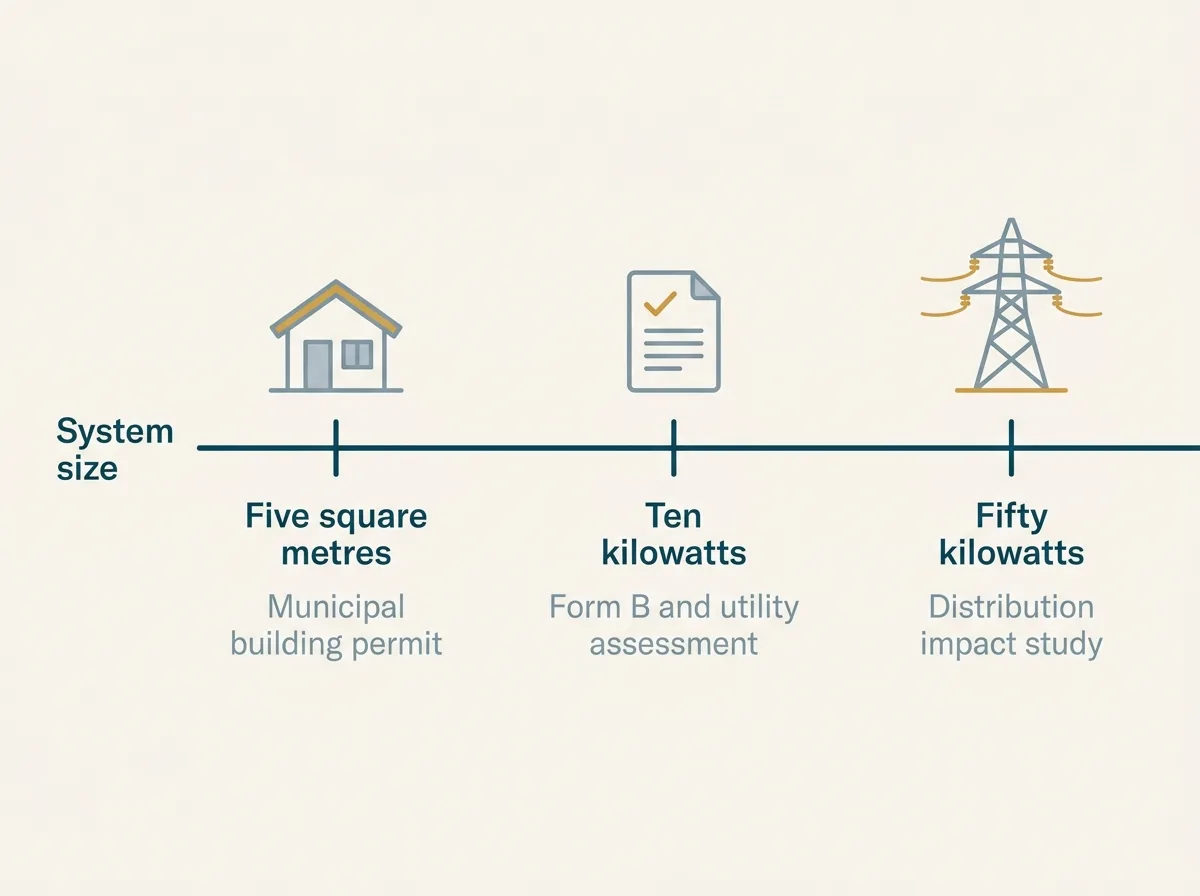
There are three lines that matter in the Greater Toronto Area. The first is 5 square metres of installed collector, which is where the municipal building permit begins. The second is 10 kW, which changes the net metering application and pulls the utility into an assessment of its own network. The third is 50 kW, which triggers a distribution impact study.
None of the three is about the panels. They are about who has to look at the job before it can be energised, and every one of them lands before a single kilowatt hour is generated. A homeowner adding two panels to a 9 kW design and a business sizing a rooftop at 49 kW instead of 52 kW are making the same kind of decision.
5 square metres, which almost every array crosses
SurgePV states that the City of Toronto requires a building permit for any PV installation larger than 5 square metres, with processing of roughly two to three weeks. Solar Energies in Canada lists the Toronto fee at $214.79 for a solar collector system over that size and Mississauga at a $244 residential minimum plus a $50 online administrative fee.
Five square metres is not much roof, so in practice every real residential array needs the permit, and the threshold is worth knowing mainly so nobody assumes a small system escapes it.
The permit is a structural question, not an electrical one. SurgePV notes that Ottawa and several other Ontario municipalities require it specifically to confirm the roof can carry the weight of the array, and that rural municipalities vary, with some running expedited processes for small residential systems. The paperwork behind a GTA solar install sets out how this fits with the other two approvals.
10 kW, where the utility starts assessing
The 10 kW line changes three things at once, and it is the one most often missed in a proposal.
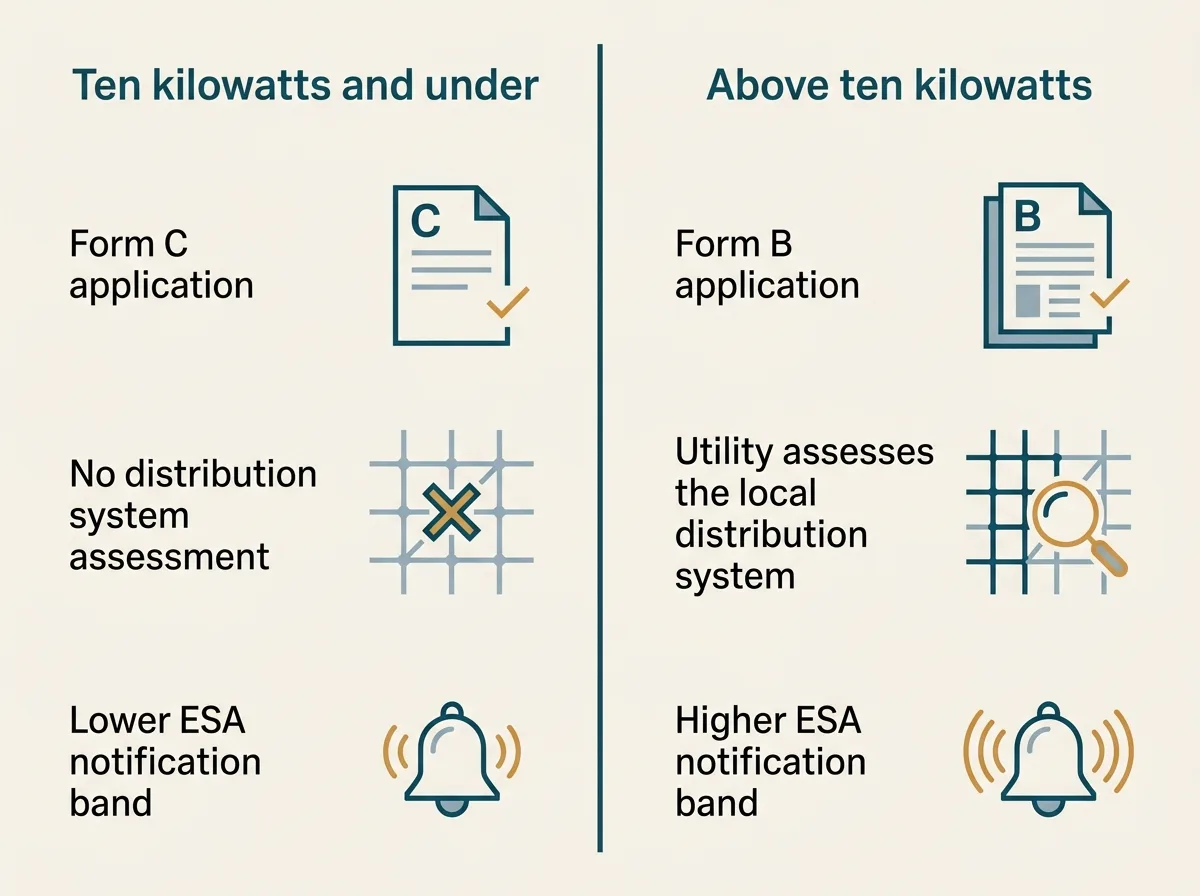
SurgePV states that Ontario's net metering application uses Form C for systems of 10 kW or less and Form B for anything larger, that all of the province's roughly 60 local distribution companies are required to offer net metering, and that the utility assesses the effect on its local distribution system for systems over 10 kW. That assessment is a review of the network, not a form the applicant fills in, and it takes the time it takes.
The ESA fee steps at the same point. SolarCalculatorHQ puts the notification at $165 for a residential PV system under 10 kW and $235 for inverter capacity in the 10 to 50 kW band, with a $95 inspection fee in each case. SurgePV notes that ESA wiring and licensing fees rose 1.9 percent effective 1 April 2026, so a quote written before that date understates the line slightly.
The utility's own connection charge does not step here, but it does vary by address. SolarCalculatorHQ lists the connection impact assessment at $229 with Toronto Hydro, $211 with Alectra and $306 with Hydro One for residential systems under 10 kW. Which distributor serves the property is therefore worth establishing before the proposal is priced, not after.
50 kW, where the study arrives
Above 50 kW the local distribution company runs a distribution impact study, which SolarCalculatorHQ prices at $2,500 to $8,000. It is a separate piece of engineering work about the network the system connects to, and it is the point at which a solar project starts to look like an infrastructure project.
The money is the smaller half of it. A study is a queue as much as a fee, and a rooftop designed at 52 kW to squeeze in four more panels buys the study, the queue and the review for the sake of a few percent more output. A 49 kW design is a materially simpler project, and that is a real engineering choice rather than a trick.
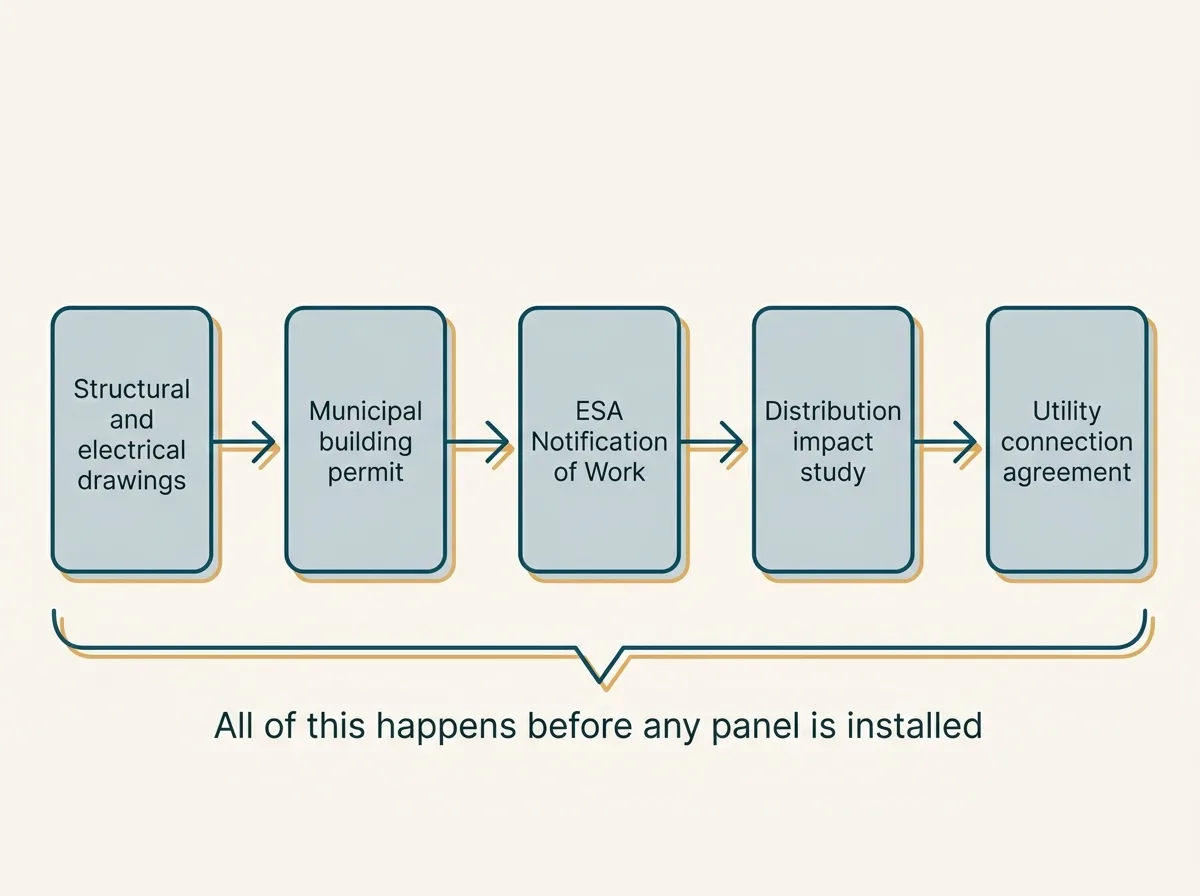
Engineering is not optional at this scale either. SolarCalculatorHQ puts P.Eng stamped drawings for CSA C22.1 Section 64 compliance at $1,500 to $5,000 and a building permit for structural certification at $500 to $3,000. Taken together with the study, SolarCalculatorHQ puts permits and grid-impact studies for a 50 kW rooftop at $5,000 to $11,000, roughly 4 percent of the $130,000 to $160,000 it uses as an installed benchmark for that capacity.
Those are soft costs, and they land before a panel is on the roof. A proposal that omits them is not comparable to one that includes them, which is the single most common reason two commercial bids on the same building are impossible to read against each other.
What the electricity itself is worth does not change
One thing does not step at any of the three thresholds. The billing arrangement works the same way at 5 kW and at 500 kW.
The Ontario Energy Board describes net metering as a billing arrangement in which generation beyond your own use flows to the grid and returns as a credit on your electricity bill. The credit applies to the electricity you consume, and the Ontario Energy Board states that credits may be carried forward for at most 12 months, after which they drop to $0. Exported power is credited against a bill, not paid out.
That rule shapes sizing at every scale. A system built well above the building's own annual consumption accumulates summer credits that have to be spent within the same year, and a larger array does not change the arithmetic. What Ontario net metering actually pays you sets out the mechanics, and the net metering calculator starts from consumption rather than roof area for the same reason.
The Ontario Energy Board also sets the eligibility condition behind that requirement: net metering is open to you where the renewable generation is primarily for your own consumption. Sizing to the bill is not conservatism. It is the shape the programme was built for.
What the per watt price does across the range
Larger systems cost less per watt, and the reason is exactly the soft costs described above.
Green Building Canada puts Ontario commercial rooftop solar at $2.15 to $3.00 per watt installed against a Canadian average of $1.90 to $2.80, and in whole-system terms gives $47,500 to $70,000 at 25 kW, $95,000 to $140,000 at 50 kW, $190,000 to $280,000 at 100 kW and $475,000 to $700,000 at 250 kW. Two credible sources disagree on the 50 kW figure: SolarCalculatorHQ's 2026 permit calculator uses a $130,000 to $160,000 installed benchmark for the same capacity, so read the honest band as roughly $95,000 to $160,000.
Engineering, permitting and crew mobilisation cost roughly the same whether the array is 25 kW or 500 kW. Spreading them over more watts is where the per watt figure falls, and it is why a 4 kW residential array so often looks like poor value next to an 8 kW array on the same roof.
On the residential side SolarCalculatorHQ puts Toronto and the GTA at $2.95 to $3.30 per watt, the highest band in Ontario. Our commercial solar cost guide and solar panel installation cost guide carry both sides with every source named.
One more line belongs in a commercial business case. Green Building Canada puts ongoing operations and maintenance at 0.2 to 1 percent of system cost per year and an inverter replacement at 10 to 15 percent of system cost every 10 to 15 years. We found no credible Canadian source publishing commercial payback periods with their assumptions stated, so this site does not print one.
Who in the GTA quotes work at this scale
Twenty of the 161 companies in this index list commercial solar. That is the pool this site can show you, against 143 listing residential panel installation.
Those twenty are not a shortlist and this site does not rank them. The index records the categories a company's own listing supports, and holds no licence status, no bonding, no scope of work, no completed-project history and no employee count for any record on it. Ninety of the 161 companies carry a rating at all, so more than a third of the index has no public score of any kind. The commercial solar category page shows what is there and our methodology page states plainly what is not checked.
For a project past 10 kW, the useful screening question is not who is largest. It is who has taken a Form B application through your specific distributor, and who has commissioned a distribution impact study before. Neither of those facts appears in any listing on this site, and both are answerable in a five minute phone call.
Frequently asked questions
What is different about a solar system over 10 kW in Ontario?
- The application and the review. SurgePV states that net metering uses Form C at 10 kW and below and Form B above it, and that the local distribution company assesses the effect on its distribution system for systems over 10 kW. The ESA fee band also steps: SolarCalculatorHQ puts the notification at $165 under 10 kW and $235 from 10 to 50 kW, plus a $95 inspection in each case.
What happens above 50 kW?
- The utility runs a distribution impact study, priced by SolarCalculatorHQ at $2,500 to $8,000, on top of the engineering a commercial job already needs. The same source puts P.Eng stamped drawings for CSA C22.1 Section 64 compliance at $1,500 to $5,000, a structural building permit at $500 to $3,000, and permits and grid-impact studies for a 50 kW rooftop at $5,000 to $11,000 in total.
Do I need a building permit for a small array?
- In Toronto, for anything over 5 square metres, which is about two or three panels. SurgePV puts processing at roughly two to three weeks and Solar Energies in Canada lists the Toronto fee at $214.79 for a solar collector system over that size, with Mississauga at a $244 residential minimum plus a $50 online administrative fee. Municipal rules vary elsewhere in Ontario.
Does a bigger system earn more from net metering?
- Not in the way people expect. The Ontario Energy Board describes net metering as a billing arrangement where exported generation returns as a credit against the electricity you use, and says credits carry forward for at most 12 months before dropping to $0. A system sized well above the building's own annual consumption builds up credits that can expire unused, whatever its capacity.
How much does commercial rooftop solar cost in Ontario?
- Green Building Canada puts Ontario commercial rooftop solar at $2.15 to $3.00 per watt installed, which works out at $47,500 to $70,000 for 25 kW, $95,000 to $140,000 for 50 kW and $190,000 to $280,000 for 100 kW. SolarCalculatorHQ's 2026 benchmark for a 50 kW rooftop is higher at $130,000 to $160,000, so treat roughly $95,000 to $160,000 as the honest band at that size.