Hiring a Commercial Solar Contractor in Toronto
Last updated By The SolarPanelFinder Rooftop Desk
A Toronto business looking for a commercial solar contractor has a short, spread-out field to work with. Of the 161 companies in this index, 20 list commercial solar. They sit in 15 different areas, and 14 of them also do residential work. Shortlist three, compare proposals per watt, and settle the roof and utility questions before any price is final.
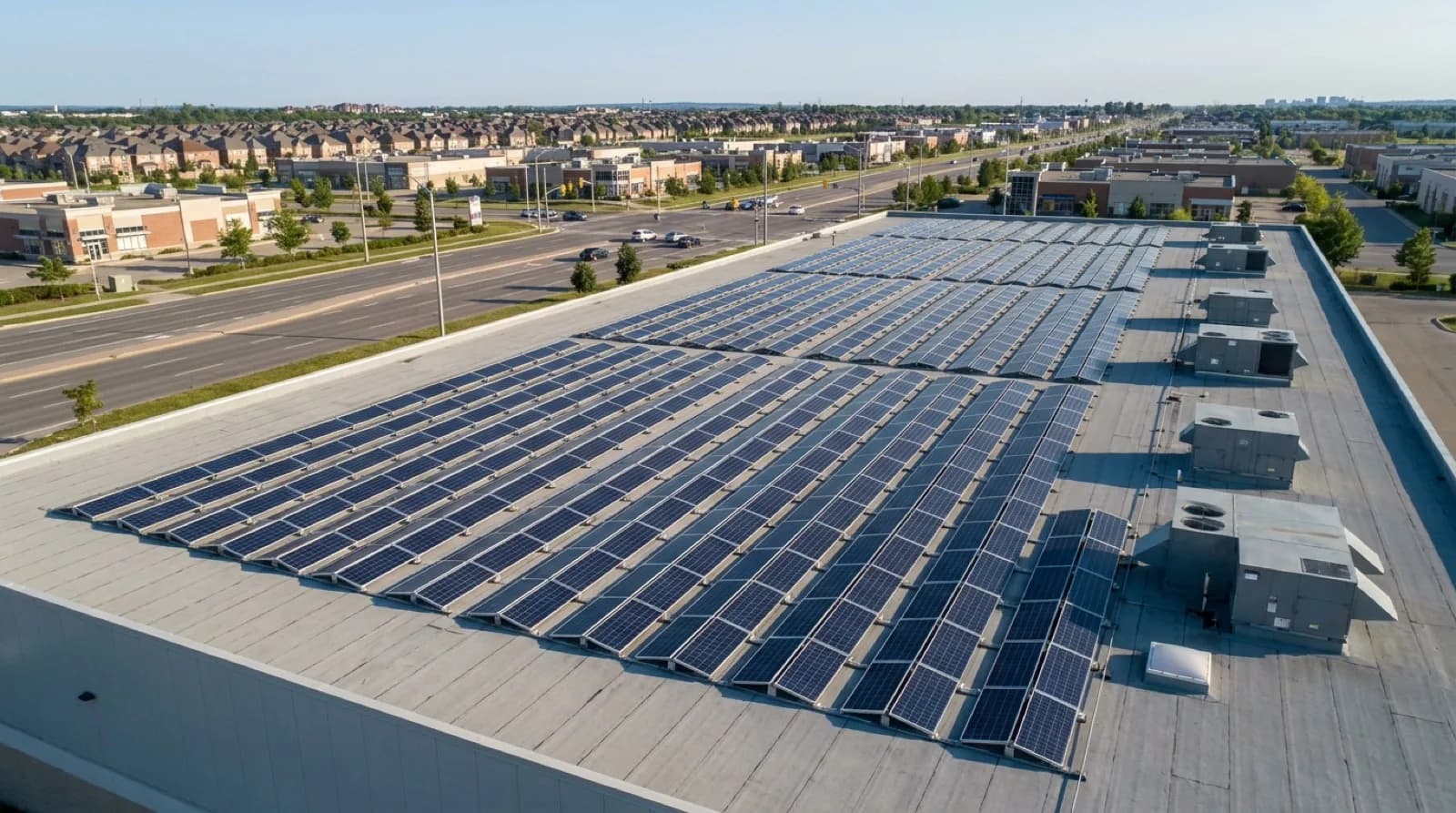
How big is the commercial field?
Twenty companies sit in the index's commercial solar category. That is about one in eight of the 161 the site holds, and it is a list a facilities manager can read in an afternoon. A Google rating appears on 14 of the 20, with 305 reviews between them, and every one of the 20 has a website on record.
The field is not concentrated downtown. Willowdale, Markham, Oshawa and Islington-City Centre West hold 2 commercial companies each. Harbourfront, Leslieville, Leaside, the Financial District, Bayview Village, Brampton, Richmond Hill, Pickering, King West, Yonge & St. Clair and Vaughan hold 1 each, and one record carries no area. These counts come from the site's August 2026 dataset of public Google records, and corrections go to hello@solarpanelfinder.ca. A business in Scarborough and one in Etobicoke choose from roughly the same list. A recorded address says where a company sits, not where it works.
Specialists or companies that also do houses?
Most are both. Of the 20 commercial companies, 14 also list solar panel installation for homes, which is the site's residential category. The other 6 describe commercial work without listing panel installation:
- Haneco Lighting Canada Inc, Markham, rated 4.6 on 33 reviews, which Google labels an energy equipment and solutions business.
- Alectra Energy Solutions Inc., Vaughan, rated 1.7 on 6 reviews, with the same Google label.
- CF Green Energy Solutions, Pickering, rated 5.0 on 4 reviews, labelled a lighting contractor.
- Circuit Energy, Willowdale, rated 5.0 on 9 reviews, which also lists design and consulting and is labelled an engineering consultant.
- Resco Energy Inc., King West, with no rating, labelled an electrician.
- Enerforge, Oshawa, with no rating and no Google label.
The labels show that "commercial solar" covers different kinds of business. Among them are lighting and energy firms, an engineering consultancy and an electrical contractor. For a rooftop array, ask each one early whether it designs and builds the system itself or manages subcontractors. Either model can deliver a working array, but you should know who is on your roof.
Among the companies that do both kinds of work, two have the largest review histories. Solify in Bayview Village is rated 4.3 on 107 reviews, and New Dawn Energy Solutions in Markham is rated 4.6 on 65. A residential review record says something about how a company treats customers. It says little about how it runs a 100 kW job, so ask for commercial references as well.
What should a commercial array cost?
Green Building Canada's 2026 guide to commercial solar costs puts the Ontario average at $2.15 to $3.00 per watt. It gives $1.90 to $2.80 across Canada and $1.90 to $2.60 in British Columbia. Its size table gives these installed ranges:
- A 25 kW system: $47,500 to $70,000
- A 50 kW system: $95,000 to $140,000
- A 100 kW system: $190,000 to $280,000
- A 250 kW system: $475,000 to $700,000
- A 500 kW system: $950,000 to $1.4 million
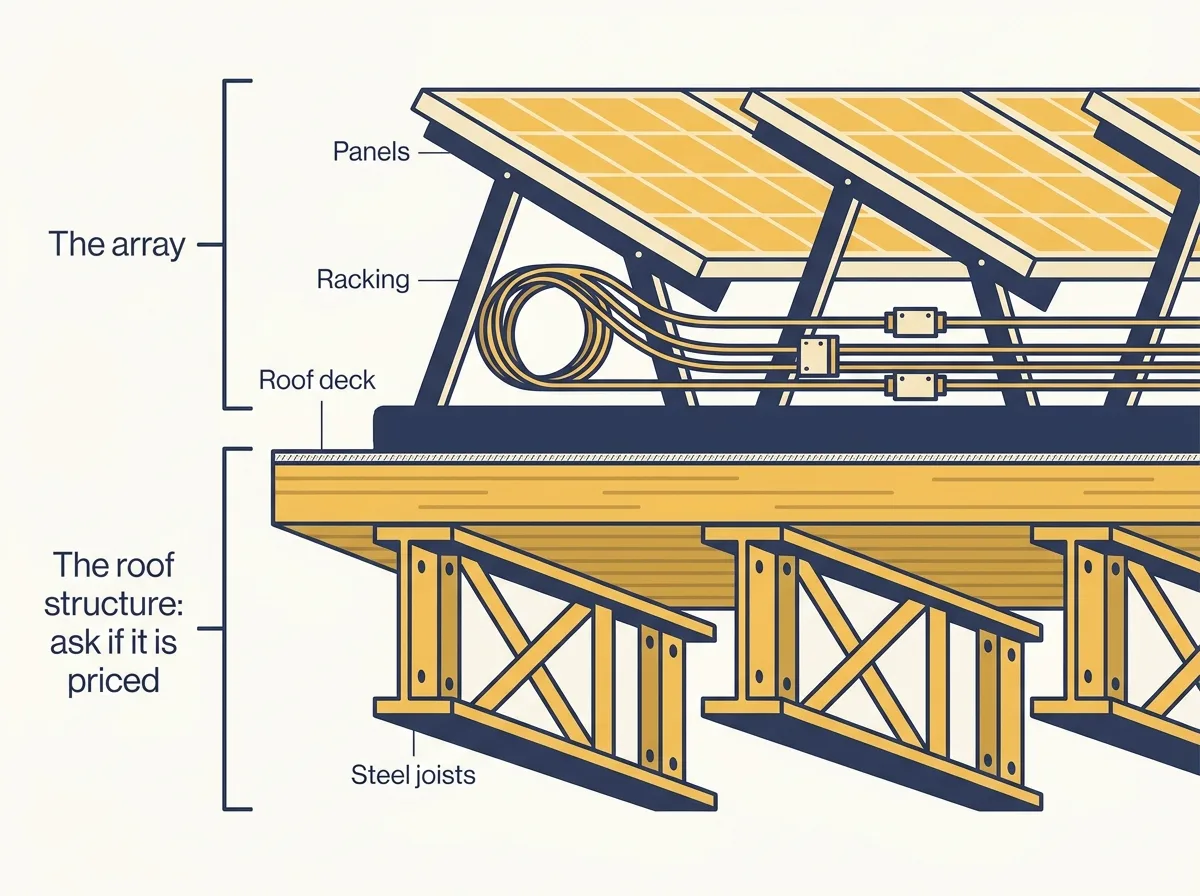
Those are Canada-wide system figures. Green Building Canada also works out a cost per square foot of roof, at $28.50 to $56. It bases that on a rule of thumb that commercial rooftops generate about 15 to 20 watts per square foot. It says those figures cover panels, racking (the frames that hold the panels), wiring and labour. They leave out structural work such as roof reinforcement, which it says can be significant for aging buildings.
That exclusion is the most important line for a Toronto building owner. Price every proposal per watt so you can compare it with the Ontario range. Then ask each contractor, in writing, whether the roof has been assessed and what happens to the price if it needs work. The site's commercial solar cost guide sets out the published ranges in full.
Why does one building cost more than another?
Green Building Canada lists the site factors that move a commercial price. Most are about the building, not the panels. It names the type of site, such as an industrial roof, a farm barn or a parking-lot canopy. It says new and aging buildings raise different issues. It points to roof strengthening for wind, snow or hail loads. It also points to tying the array into the building's electrical, heating and cooling systems. Places with hail or heavy snow, it adds, need a structural design made for them.
For a GTA owner, that turns into a short list to have ready before the first site visit. Gather the roof's age and last replacement date, any structural drawings, the layout of rooftop equipment, and the size and age of the building's electrical service. A contractor who asks for none of that before pricing is pricing a generic roof, not yours.
It also explains why two proposals for the same kW can sit far apart. One may have priced the roof and the electrical tie-in, and the other may have left them out.
Who handles the approvals?
Ask this before comparing prices, because a proposal that leaves the approvals to you is not the same product as one that includes them. Three sets of approvals apply.
Electrical. The Electrical Safety Authority (ESA) says Ontario's electrical code requires almost all electrical work to be reported to it. A notification of work is filed before the work starts. It tells property owners to hire a Licensed Electrical Contractor and to check the ECRA/ESA licence number. (ECRA is the Electrical Contractor Registration Agency.) The index holds no licence status for any company, so ask who that contractor is.
Building. The City of Toronto's permit guide says solar panels over 5 square metres on the roof or walls of any building need a building permit. A commercial rooftop array is far larger than that.
Utility. Toronto Hydro publishes one set of connection steps for small generators of 12 kW or less and a separate set for projects greater than 12 kW. Alectra Utilities draws the same 12 kW line for its micro-generator process. Every size in Green Building Canada's commercial table, from 25 kW up, falls in the larger group, so ask who prepares the application and follows it up. The site's guide to what changes as a solar system grows walks through the size thresholds.
What does the array cost to run?
A commercial proposal should include the years after the ribbon-cutting. Green Building Canada says average maintenance cost would be 0.2 to 1 percent of system cost per year. Inverters are the units that convert the panels' output into usable power. Green Building Canada says replacements are typically needed every 10 to 15 years and may cost 10 to 15 percent of the system cost. On a 100 kW array priced at the bottom of its size table, that inverter line alone is a five-figure planning item.
Ask each contractor whether it offers a service plan for running the array. Ask what monitoring is included, and who responds when output drops. The index lists only 4 companies in its repair and maintenance category. None of them is among the 6 commercial firms that do not list installation, so plan on after-sale support coming from the contractor you hire.
Questions for the shortlist
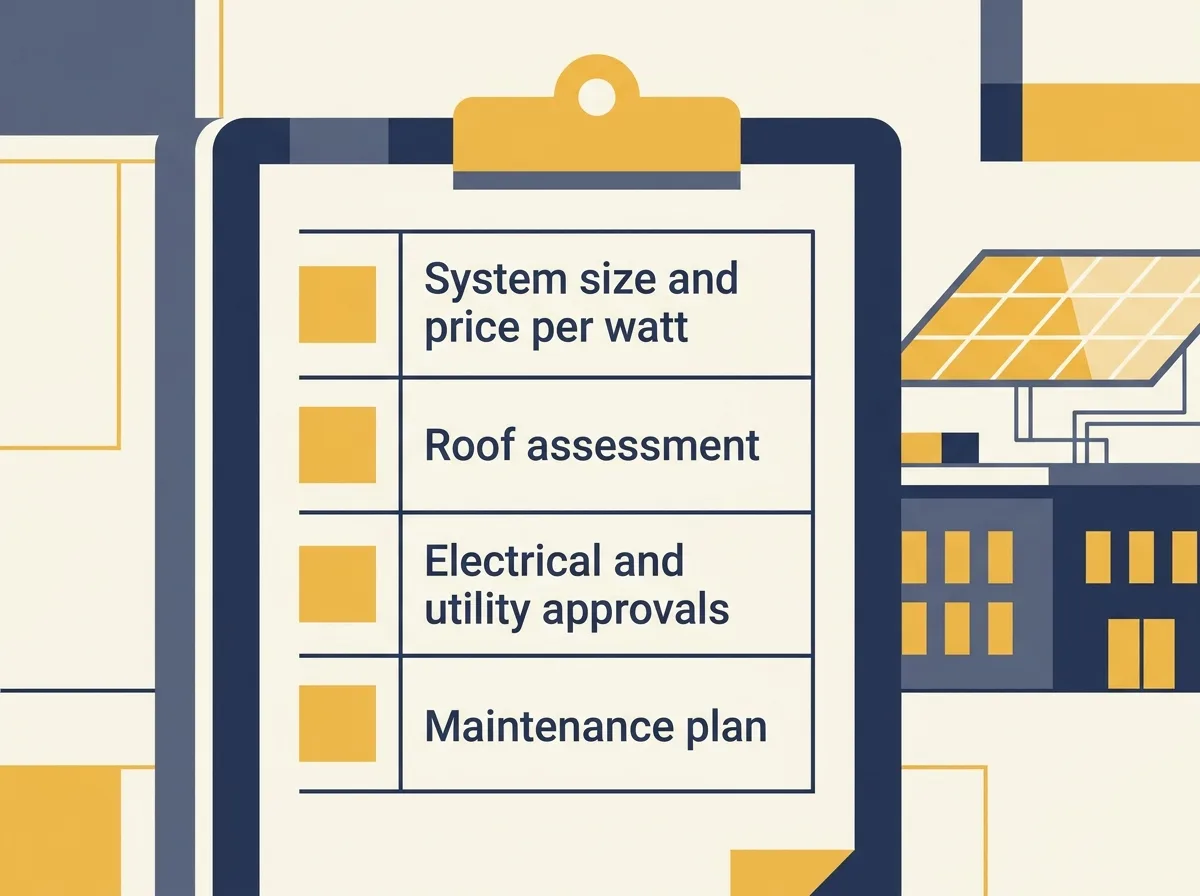
- Which comparable commercial systems have you built, and can we speak to the owners?
- What size is the proposed system in kW, and what is the price per watt?
- Has the roof been assessed, and is any structural work excluded from the price?
- Who is the Licensed Electrical Contractor on the job?
- Who prepares and follows up the utility application?
- What operations and maintenance do you offer, and at what annual cost?
- Which warranties apply to panels, inverters and workmanship, and for how long?
- Is the price before or after harmonized sales tax (HST)?
The site's methodology page explains how companies are ordered in the category list. It builds a shortlist and does not check licences, insurance or Workplace Safety and Insurance Board (WSIB) coverage, so those checks stay with the business doing the hiring.
Frequently asked questions
How many commercial solar contractors are there in the GTA?
- In this index, 20 of the 161 solar companies list commercial solar as a category. Of those, 14 also list residential panel installation, and 6 do not. They are spread across 15 areas, from Markham and Willowdale to Oshawa and Islington-City Centre West, with one record carrying no area.
What does commercial solar cost in Ontario?
- Green Building Canada puts the Ontario average at $2.15 to $3.00 per watt, above its Canada-wide range of $1.90 to $2.80. Its Canada-wide size table gives $95,000 to $140,000 for a 50 kW system and $190,000 to $280,000 for 100 kW. It says its per-square-foot estimates exclude structural upgrades such as roof reinforcement.
What should a business ask a commercial solar contractor?
- Ask for comparable commercial work and the system size in kW, with a price per watt. Ask what the proposal leaves out, and who handles the electrical notification and the utility application. Then ask how the roof will be checked, and what upkeep will cost each year once the array is running.
Does the size of a commercial array change the paperwork?
- Yes. Toronto Hydro sets out one connection process for small generators of 12 kW or less and a separate one for larger projects, and Alectra Utilities uses the same 12 kW line. Every size in Green Building Canada's commercial cost table, from 25 kW up, is in the larger group.
Sources
- Green Building Canada, What Commercial Solar Panels Cost in Canada in 2026
- Electrical Safety Authority, Notifications and Inspections
- Electrical Safety Authority, Hire a Licensed Electrical Contractor
- City of Toronto, Solar Collectors building permit guide
- Toronto Hydro, Generation and storage connection process
- Alectra Utilities, Connecting Generation
- Electrical Safety Authority, How much does an electrical notification cost
- SolarPanelFinder, How SolarPanelFinder ranks companies (methodology, updated 31 August 2026)