How to Read Solar Reviews Before Booking a Quote
Last updated By The SolarPanelFinder Rooftop Desk
Read the review count first and the star rating second. Of the 161 GTA solar companies in this index, only 90 carry a Google rating. The median rated company has 8.5 reviews, and 38 of the 47 perfect fives rest on fewer than 10. A rating starts a shortlist. It never settles who works on your roof.

What does a star rating in this index rest on?
A rating is an average of whatever reviews a company has collected on its Google record, and in this market that is often very little. Of the 161 companies the index holds, 90 carry a rating and a review count. The remaining 71 have neither. Those 71 are still real businesses with real records: 50 of them have a website on record and all 71 sit in a mapped area. They simply have no reviews for anyone to average. Every count in this guide comes from the site's August 2026 dataset of public Google records, and corrections go to hello@solarpanelfinder.ca.
Among the 90 rated companies there are 3,646 reviews in total. That sounds like a lot until you see how they spread. The median rated company has 8.5 reviews, which means half the rated field sits below that line. Exactly 1 review sits behind 17 companies, and 5 or fewer behind 37. At that volume, one enthusiastic customer or one angry one decides the number you see.
The mean rating across the 90 is 4.61 and the median is 5, with a range from 1.7 to 5. Only 9 rated companies sit below 4. Put plainly, almost every rated solar company in the GTA looks good on stars, which is exactly why stars alone cannot separate them.
Why is a perfect five the weakest signal on the page?
Because it is the easiest score to reach with the least evidence. In the index, a perfect 5 appears on 47 of the 90 rated companies. Of those 47, 38 rest on fewer than 10 reviews. A company that has finished a handful of jobs for friends and neighbours can hold a flawless average for years without a single hard case showing up in it.
That does not make a new company a bad choice. The site's methodology notes that solar has a lot of young companies, and a small review count is what youth looks like. It means the rating has not yet been tested. Treat a 5.0 on 6 reviews and a 4.6 on 400 as two different kinds of evidence rather than a ranking where the 5.0 wins.
A practical way to read it:
- Under 10 reviews: the rating is an anecdote. Read every review in full and look at the dates.
- Between 10 and 50 reviews: the rating starts to mean something, but a few old reviews can still carry it.
- Several hundred reviews: the average is stable, and the useful information has moved into the low-star reviews and the company's replies.
Only 10 rated companies in the index have 50 or more reviews, and 8 have 100 or more, so most of the market sits in the first two bands.
What do the one-star reviews tell you?
More than the five-star ones, provided you read them for patterns rather than counting them. Across all 3,646 reviews in the index, 3,082 are five-star, 211 are four-star, 59 are three-star, 40 are two-star and 254 are one-star. Reviews in this index cluster at the two ends of the scale, so a company's middle is usually thin.
At least one one-star review appears on 38 companies. Of those 38, 33 still have more five-star reviews than one-star ones, which is normal for a business that has done enough work. What matters is what the complaints are about. A one-star review about a salesperson who called too often says something different from three one-star reviews, a year apart, about an array that stopped producing and a company that stopped answering.
Look for three things in the low-star reviews:
- Repetition. The same complaint from different reviewers at different times is a pattern. A single bad week is not.
- After-sale issues. Solar is a long commitment, so complaints about service calls, monitoring or warranty claims weigh more than complaints about the sales process.
- The reply. A specific, factual reply that explains what was done is a better sign than silence or a copy-paste apology.
How does SolarPanelFinder weigh a rating against its review count?
The site publishes its method on its methodology page, and the review part of it is designed to stop a thin perfect score from outranking a long record. Every company is treated as though it began with 10 reviews sitting at the dataset mean of 4.61 stars, and its real reviews are blended in on top. A large review history swamps that starting point. A small one does not.
The page's own worked example shows the effect. An invented company with a perfect 5 on 8 reviews earns 28 of the 40 review points, while an invented company with 4.8 stars on 280 reviews earns 36. Review volume adds up to 14 of those 40 points on a scale that stops rising at 200 reviews.
You can apply the same idea by eye. When two companies look alike on stars, the one with more reviews behind the number has given you more to go on. The review points are also only 40 of the 100. The rest of each company's score comes from what it states on its own website and how complete its public record is. The methodology says it checks none of those statements against a registry.
What does a very large review count prove?
That a company has done a lot of work and asked a lot of customers for reviews. It does not prove that the crew who comes to your house is the crew those reviews describe. The three largest review counts in the index are 790 for Xolar, 665 for Solar X and 499 for Polaron Solar Energy. Together they hold 1,954 of the 3,646 reviews, about 54 percent of every review the index records.
Two details are worth knowing when you read those big records. First, a brand can have more than one Google record. Solar X appears in the index at Church-Wellesley with 665 reviews, and under separate records in Vaughan, Oakville and Oshawa with far fewer. Reviews do not pool across those records. Second, Google's content policy says a review should reflect an actual experience with a business. Reviews posted because a business offered payment, discounts or free goods or services are not allowed and will be removed. A big count is still a real signal. Google's removal rule does not mean every review on a record has been checked.
What can reviews not tell you at all?
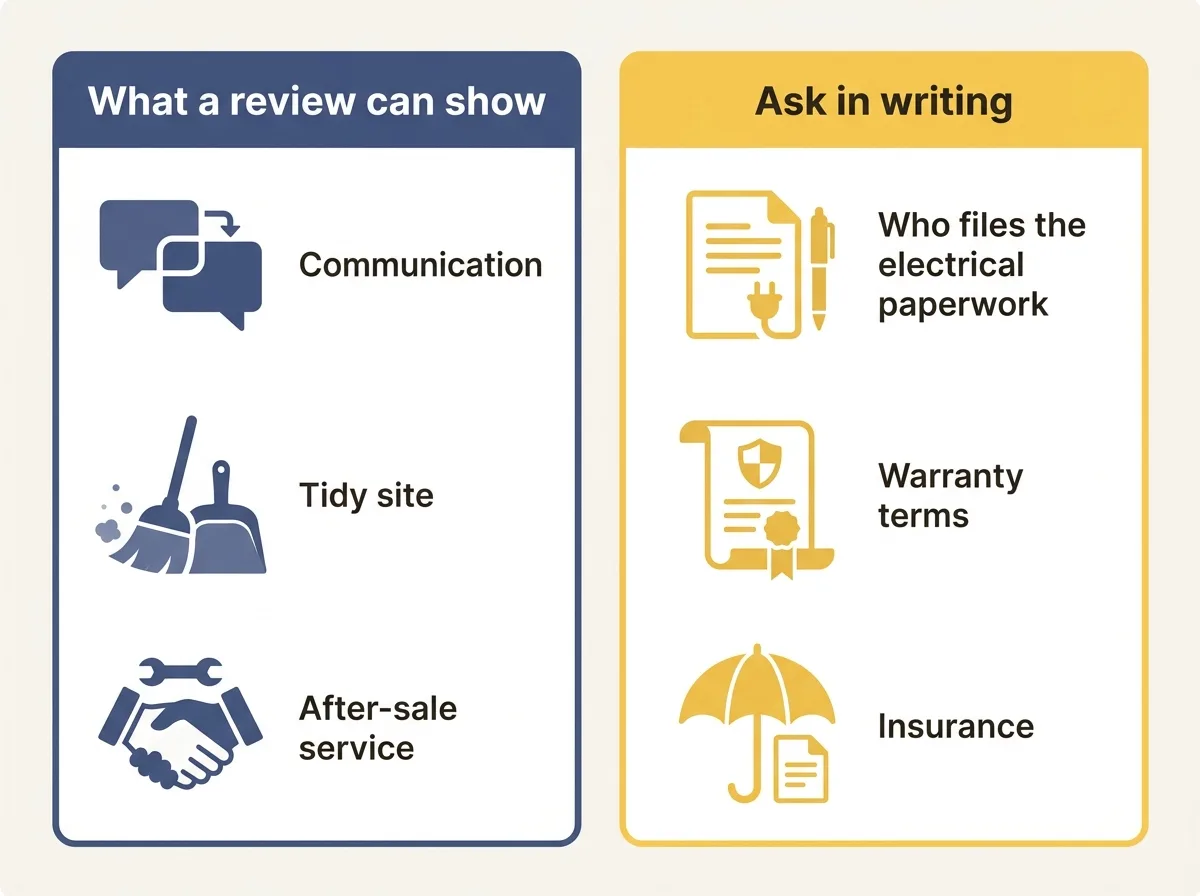
The things that matter most on what the site's methodology calls a 25-year roof commitment. The index holds no licence status, no insurance details, no warranty terms and no job-completion data for any of its 161 companies. The site's methodology says it does not check licences, insurance or WSIB coverage, and prints a company's own claims as "Says it is licensed" rather than as fact.
Some of those questions have a fixed legal answer that a review cannot change. The Electrical Safety Authority (ESA) says the Ontario Electrical Safety Code requires almost all electrical work to be reported to it through a notification of work. The person doing the work files it before the work starts. The ESA's minimum fee for a residential notification is $88. A glowing review does not tell you who will file that notification. Ask the company directly, and ask for the answer in writing.
A reading routine before you book a quote
Use reviews to build a shortlist of three or four companies, then stop reading and start asking.
- Filter by category first. Start from the solar panel installation category or the category that matches your job, so you are comparing like with like.
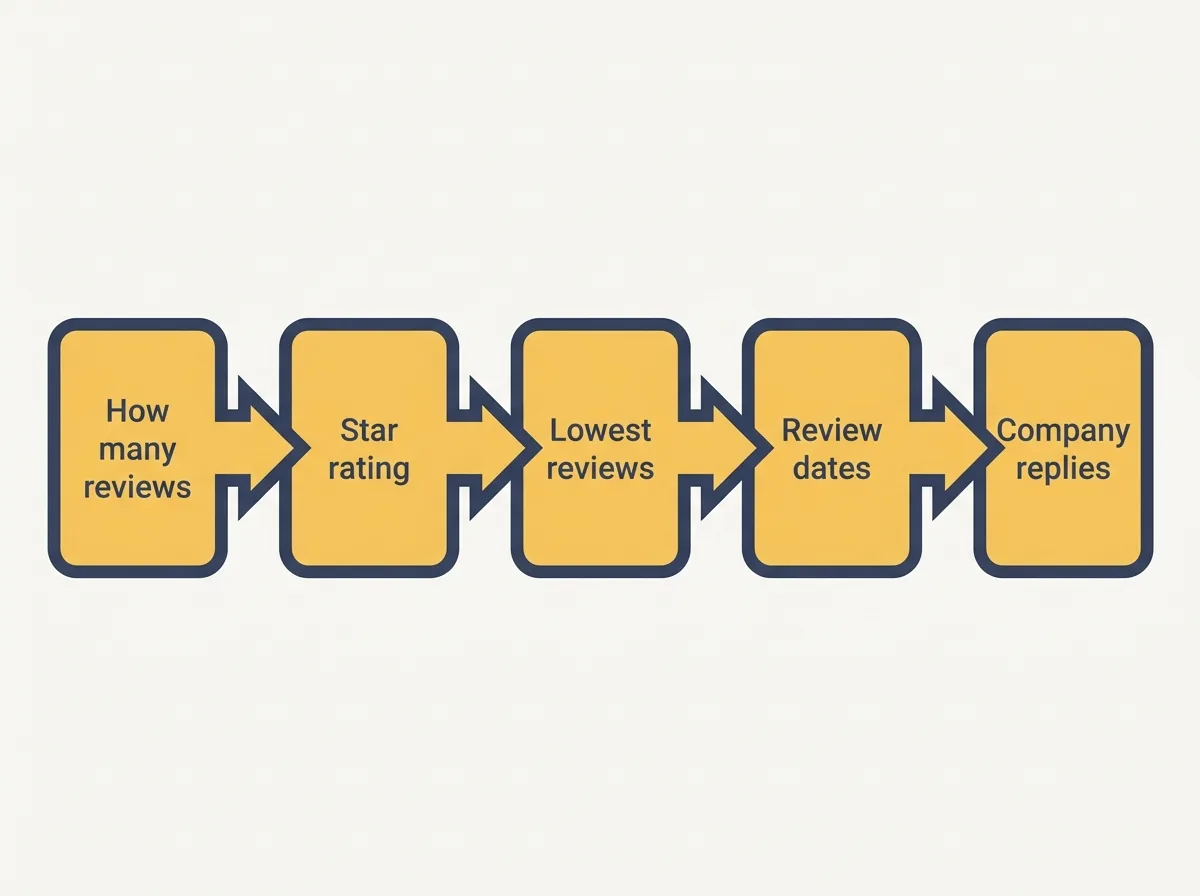
- Read count, then rating. Note how many reviews sit behind each score before you look at the stars.
- Read the lowest reviews in full. Look for repeated after-sale complaints and for the company's replies.
- Check the dates. A burst of reviews in one month followed by silence reads differently from a steady trickle over years.
- Do not discard unrated companies. No rating appears on 71 of the 161, and some of them may be exactly the local firm you want. Judge them on their own website and on the answers they give you.
- Move the real questions offline. Licence, insurance, warranty terms and who files the ESA notification all belong in writing before you sign. The geography of the market is laid out in the guide to where GTA solar companies cluster.
Frequently asked questions
How many GTA solar companies have Google reviews?
- In this index, 90 of the 161 solar companies carry a Google rating and a review count. The other 71 have no rating on record. Across the 90 rated companies there are 3,646 reviews in total, but they are unevenly spread: the median rated company has 8.5 reviews, and 17 companies have exactly one.
Is a 5-star solar company a safe choice?
- A perfect score tells you less than it seems. In the index, a 5 appears on 47 of the 90 rated companies, and 38 of those 47 rest on fewer than 10 reviews. A handful of happy customers can produce a perfect average, so read how many reviews sit behind the score and how recent they are before giving it weight.
How does SolarPanelFinder rank companies with few reviews?
- Its published method treats every company as if it started with 10 reviews at the dataset mean of 4.61 stars, then blends in the real reviews. A perfect 5 on 8 reviews earns 28 of the 40 review points in the site's own worked example, while 4.8 stars on 280 reviews earns 36.
Can reviews tell me whether a solar installer is licensed or insured?
- No. Reviews describe a customer's experience, and the index holds no licence, insurance or warranty data for any of its 161 companies. The site's methodology says plainly that it does not check licences, insurance or WSIB coverage, so those questions have to go to the company in writing.
Sources
- SolarPanelFinder, How SolarPanelFinder ranks companies (methodology, updated 31 August 2026)
- Google, Maps user generated content policy, Fake and misleading content and reviews
- Electrical Safety Authority, How much does an electrical notification cost
- Electrical Safety Authority, Notifications and Inspections